Today’s 18–24-year-olds are entering a drinking landscape that looks radically different from even a few years ago.
The range of available drinks has expanded significantly. No, low and mid-strength alcohol are now mainstream across a variety of categories while cocktails and RTDs are more accessible and socially accepted. Soft and hybrid options have also lost their stigma.
At the same time, the structure of socialising has shifted. A “good night out” is no longer universally defined by alcohol consumption. Experiences, social connection, and personal wellbeing now sit alongside drinking rather than beneath it.
By contrast, 25–34-year-olds formed their early drinking habits in a more traditional environment, where alcohol played a more central and consistent role in social occasions.
The On Premise: where behaviours take shape
The On Premise remains a critical environment for shaping drinking habits. It is where consumers establish routines, experiment with categories, and build social rituals.
In 2023, the dynamic between these two groups looked familiar. 18–24s led engagement, with 64% visiting the On Premise weekly. This was compared to 58% of 25–34s.
At that point, the younger cohort still embodied the traditional expectation of being more frequent, more social, and more engaged.
Three years later, the trajectory diverges
By 2026, that relationship has shifted significantly:
- 18–24 weekly visitation declines modestly to 60%
- 25–34 visitation rises sharply, up 12 percentage points to around 70%
This is not a uniform moderation-led trend. It is a rebalancing of engagement and a signal that the two cohorts are moving in fundamentally different directions.
The divergence becomes clearer when we look at weekly participation on specific occasions.
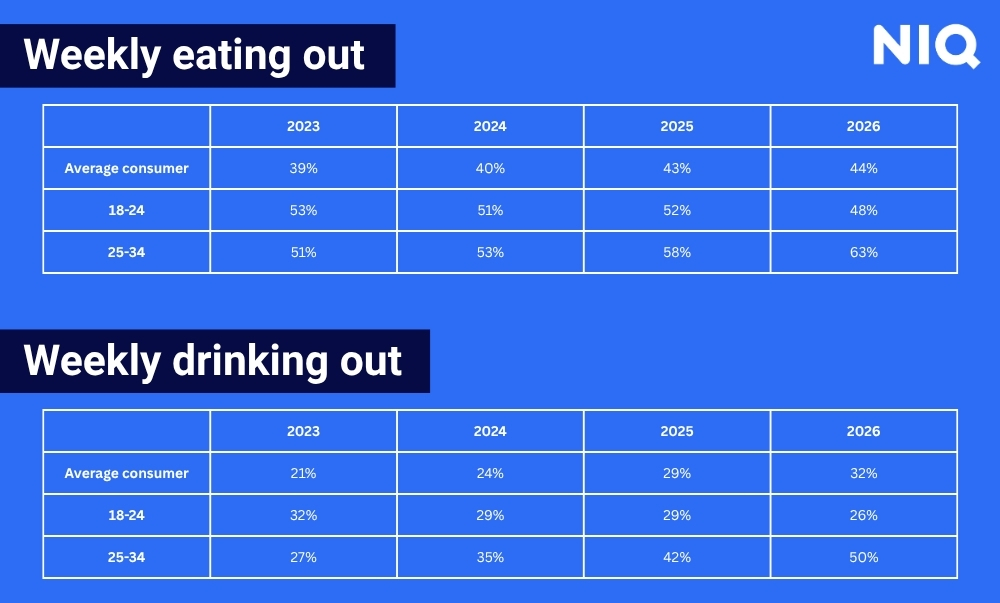
While both eating and drinking occasions continue to grow for the total population, this growth is not evenly shared. It is increasingly driven by 25–34s, while 18–24s are stepping back from routine participation.
This divergence is further reinforced when looking at outright participation. Notably, 18% of 18–24s report not drinking any alcohol when out in the On Premise, compared to just 9% of 25–34s. This highlights that a meaningful proportion of younger consumers are now actively choosing non-alcohol participation within the On Premise, rather than simply moderating within drinking occasions.
This is not just occasional behaviour. It reflects a structural shift in how this cohort engages with social occasions, where being part of the occasion does not always require alcohol consumption.
A structural shift in occasion mix
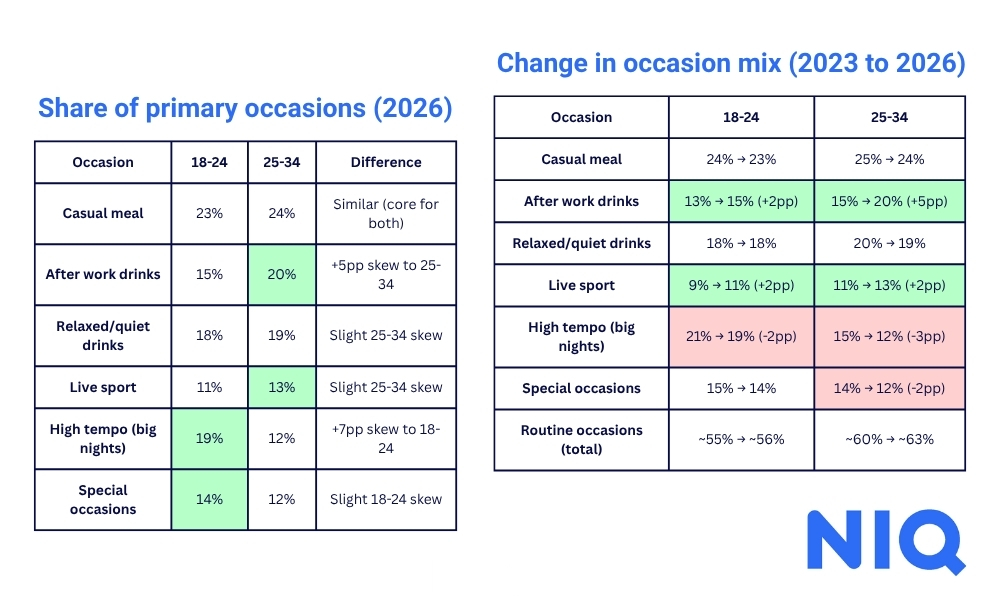
The increase in visit frequency among 25–34-year-olds is not simply a case of going out more. It reflects a structural shift in the types of occasions they prioritise.
Over the past three years, 25–34s have rebalanced their occasion mix away from lower frequency, event-led moments such as big nights out and special occasions, and towards more routine and repeatable formats like after work drinks, casual meals, and relaxed socialising.
This is important because these occasions naturally occur more frequently, allowing overall visitation to grow.
In contrast, 18–24s have maintained a more stable, event-led focus. Their behaviour continues to skew toward high tempo and special occasions. These moments deliver intensity, but they do not scale frequency in the same way.
As a result, what appears to be a generational shift in behaviours is more of a divergence in occasion structure. 25–34s are re-embedding pre-covid drinking into everyday routines while 18–24s are concentrating it into fewer, higher impact moments.
Beyond occasions: what they drink matters
Visitation behaviours only tell part of the story. What consumers drink, and how their repertoires are evolving, is critical to understanding how moderation is taking shape.
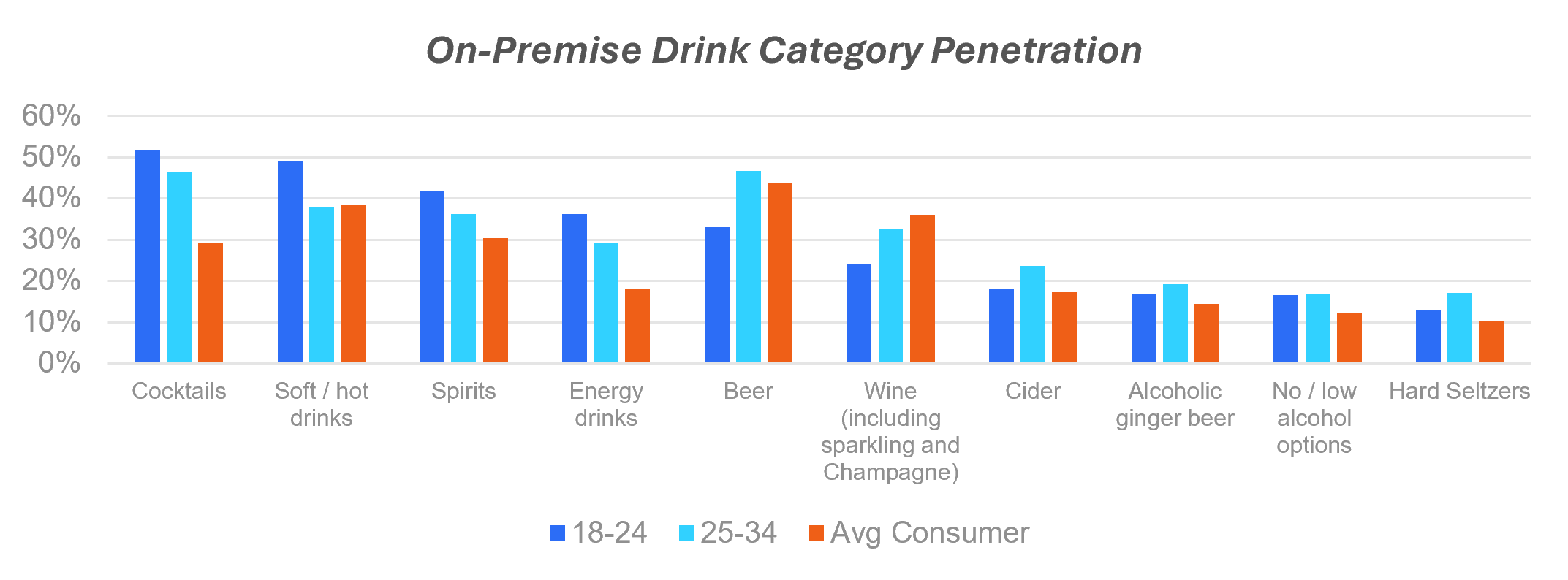
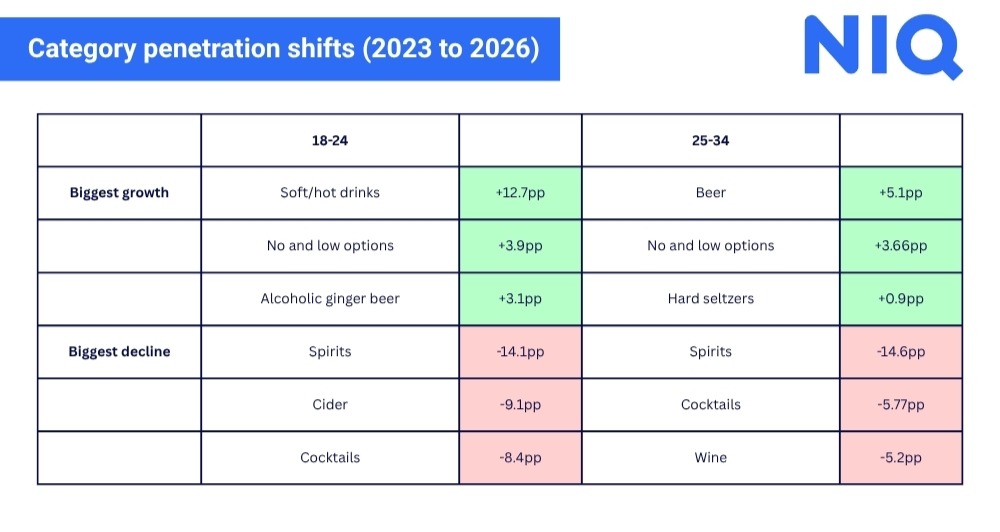
Across both groups, there has been a clear and consistent decline in higher intensity alcohol categories. Spirits have declined by around 14 percentage points in both age groups, while cocktails have also fallen, particularly among 18–24s.
These categories have historically been central to more intense drinking occasions, which makes their decline particularly important. It signals a shift away from high-intensity formats rather than a complete move away from alcohol.
Cost pressures are also playing a role in shaping drinking behaviour. Nearly half of 18–24s cite saving money as a key reason for drinking less (48%), making it the single largest driver of moderation for this group, compared to 37% for 25-34s. This helps to explain some of the decline in engagement with higher-intensity categories such as spirits and cocktails, as well as the greater openness to non-alcoholic options and, in some cases, not drinking alcohol at all when out.
At the same time, younger consumers are expanding their repertoires in a different direction.
18–24s are significantly more likely to engage with soft and hot drinks as well as no and low options when out. Combined with higher levels of non-alcohol participation, this indicates that moderation is being expressed through more varied drink choices across occasions, rather than a uniform reduction in alcohol consumption.
Their lower engagement with traditional categories such as beer and wine further reinforces that their behaviour is less anchored in traditional drinking norms.
Intensity of consumption completes the picture
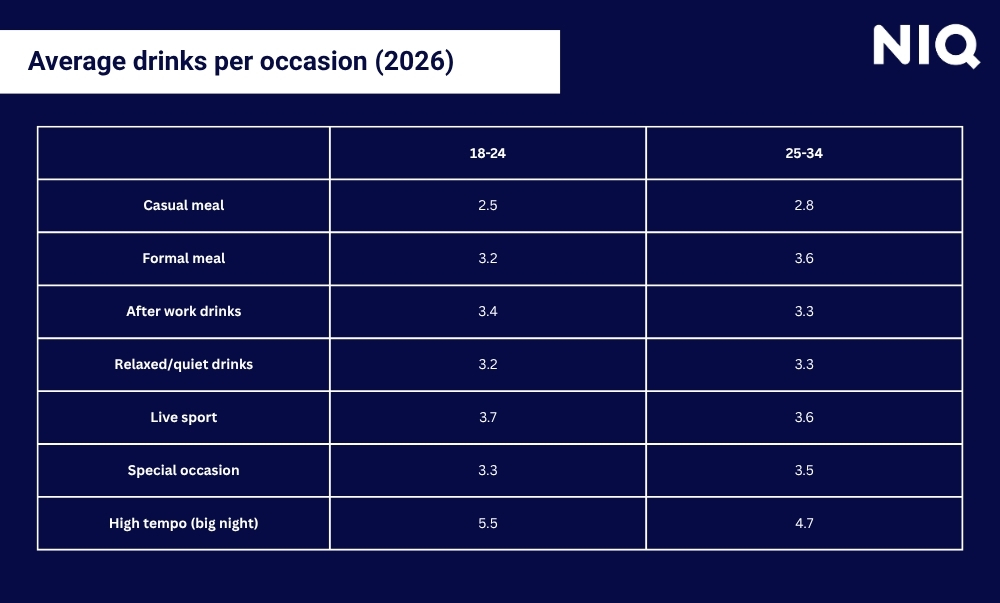
Finally, when we look at how much consumers drink per occasion in 2026, the differences between groups are more limited than might be expected.
Across most occasions, including after work drinks, relaxed socialising, and live sport, both 18–24s and 25–34s consume a similar number of drinks, typically around three to three and a half per visit.
Where they do diverge is at the extremes. On high tempo occasions, 18–24s continue to drink the most, averaging around 5.5 drinks per occasion, compared to around 4.7 for 25–34s. In contrast, on more routine occasions such as casual or formal meals, 25–34s tend to consume slightly more.
This reinforces an important point. The decline in spirits and cocktails is not being driven by consumers simply drinking less when out. Instead, moderation is more strongly reflected in which occasions people choose to attend and how often they participate in them, rather than a consistent reduction in intensity per visit.
Two distinct models of moderation
When these patterns are viewed together, two distinct models of moderation emerge across these groups, each pointing to fundamentally different relationships with alcohol in the On Premise.
18–24: moderation through selective participation
Among 18–24s, the shift is evident not just in what they drink, but how often they choose to engage.
Weekly visitation has declined over time, alongside a higher proportion who do not drink alcohol at all when out. This sits alongside broad-based declines in participation of traditional alcohol categories, most notably spirits and cocktails, which have historically defined higher-intensity drinking occasions.
At the same time, penetration growth is concentrated in soft drinks and no and low options, reflecting a wider set of choices beyond alcohol.
Taken together, this signals a clear behavioural shift. Rather than simply reducing consumption, 18–24s are becoming more selective in when they choose to participate in alcohol occasions, and increasingly comfortable attending the On Premise without drinking alcohol.
Moderation for this group is therefore not primarily about how much they drink. It is about whether they drink at all, and how frequently they opt in.
For a growing share of younger consumers, alcohol is no longer a default component of social participation.
25–34: moderation through simplification
For 25–34s, moderation takes a different form.
In contrast to 18–24s, this group has increased their frequency of visitation, driven by stronger participation in routine occasions such as after work drinks and casual meals.
While they also show clear declines in spirits and cocktails, these changes are offset by growth in participation with the beer category and continued engagement across alcohol-led occasions.
Rather than stepping away from alcohol, they are simplifying their choices within it, favouring more familiar and sessionable options that fit naturally into more frequent, repeatable occasions.
Their behaviour is defined by:
- Increasing regular participation
- More routine and repeatable occasions
- A more controlled and consistent level of consumption
Moderation here is about managing how they drink within occasions, not whether they participate in them.
Redefining moderation
Across both groups, moderation is not about a uniform reduction in alcohol consumption. It is about a reallocation of both frequency and occasion type, alongside a shift in category mix.
For 18–24s, moderation is expressed through selective participation, with lower frequency, higher non-drinking, and a reduced role for high-intensity categories such as spirits and cocktails.
For 25–34s, moderation is expressed through simplification and structure, with higher frequency, more routine-led occasions, and a shift toward lower-complexity alcohol choices.
This is reinforced by two key dynamics:
- Stable levels of drinks per occasion across most occasions
- Sustained decline in spirits and cocktails across both groups
The real challenge - The implication is clear.
The issue is no longer just how much people drink, but how often they choose to drink, and whether they choose to drink at all.
With declining visit frequency among 18–24s, nearly one in five not drinking alcohol when out, and continued declines in core categories such as spirits and cocktails, the challenge is increasingly about recruiting the next generation into alcohol occasions in the first place.
For operators and suppliers, this requires a shift in focus from driving volume within occasions to increasing participation in alcohol occasions and ensuring alcohol remains relevant within a broader, more flexible social experience.
The implications are clear. Winning with the next generation will depend less on driving volume and more on staying relevant in a changing occasion landscape.
Join our upcoming webinar to understand how to respond.
NIQ is a Platinum Partner of the Drinks Association.