Across ANZ FMCG, the commercial environment has fundamentally changed. Recent retailer commentary continues to point toward subdued consumer demand, heightened promotional activity, cost pressure, and increasing focus on operational efficiency and profitability.
Endeavour Group's Investor Day today laid out a three-year transformation plan that makes this shift impossible to ignore. The business is targeting $300 million in cost savings by FY29, exiting most of its wine production assets, and repositioning Pinnacle Drinks as a private label operation in service of its retail brands. At the same time, ranging decisions at Dan Murphy's are moving to a profitability-per-linear-metre model, meaning space allocation will be driven by data, not relationships. Retail media and trade partner data commercialisation are explicitly called out as medium-term revenue levers.
That matters because it reflects a broader shift occurring across retail and FMCG.
Historically, commercial conversations were often driven by volume growth, distribution expansion, promotional scale, and relationship strength.
Retailers are now assessing total commercial impact:
- Margin delivery
- Trade investment productivity
- Promotional effectiveness
- Working capital implications
- Retail media contribution
- Long-term customer profitability
Category growth planning, RTD ranging strategy, and data-sharing with suppliers are increasingly part of that conversation areas where supplier teams are often underprepared. Endeavour's own data shows RTD/premix delivering a +3.5% two-year sales CAGR, mid-strength beer at +5.6%, and luxury wine at +7% the categories growing are the ones requiring more sophisticated supplier conversations, not less.
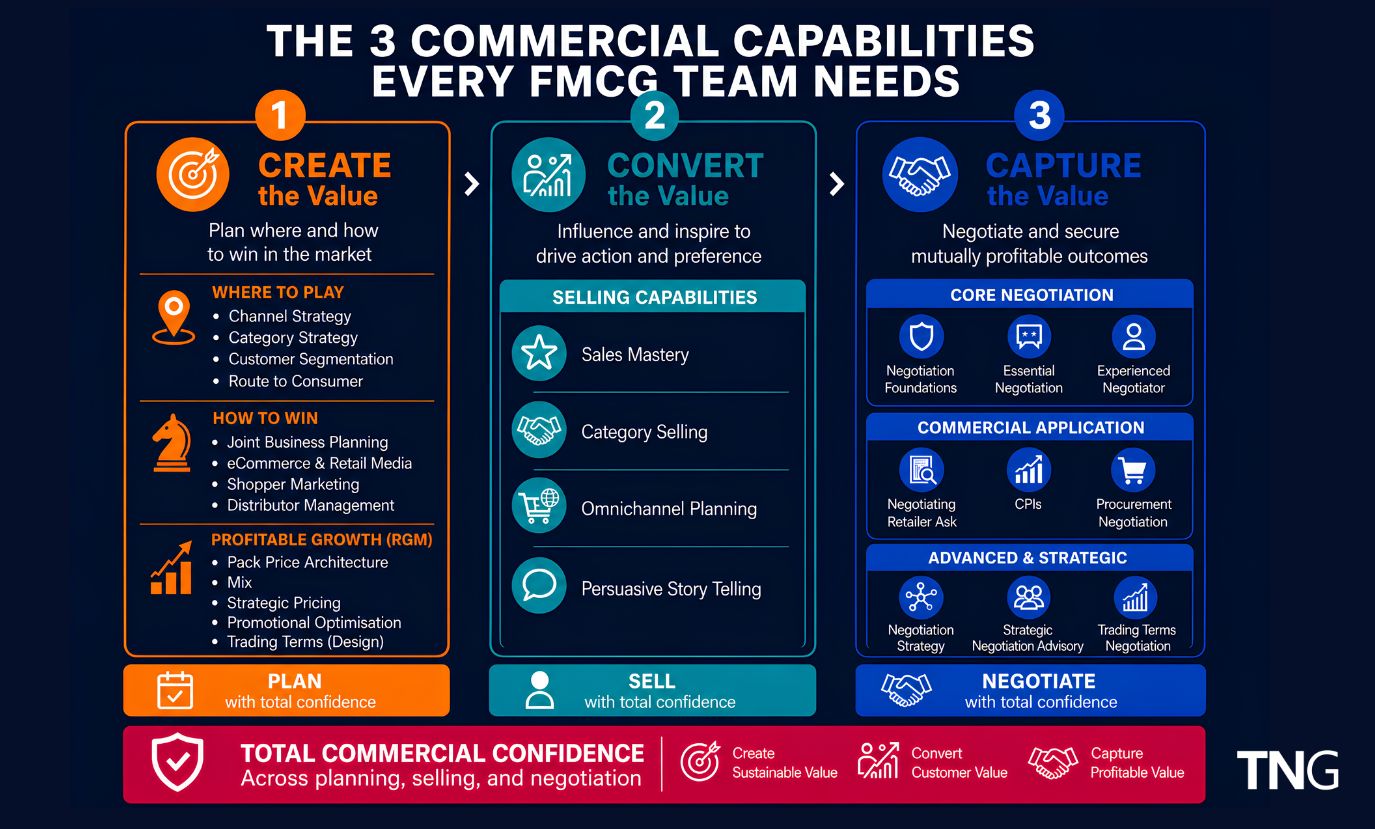
Which means supplier teams now require a different level of commercial capability. The challenge is that many organisations still operate with fragmented commercial conversations across sales, category, finance, marketing, and revenue growth management, while retailers are increasingly evaluating the entire commercial equation as one integrated discussion.
In this environment, negotiation capability becomes far more than a value creation skill. It becomes a commercial discipline.
The teams likely to perform best may not necessarily be the ones with the largest budgets or broadest portfolios. They may be the ones that can:
- Articulate commercial value more clearly
- Connect proposals to customer profitability
- Align cross-functional commercial thinking internally
- Execute with greater financial and commercial fluency
As pressure across FMCG continues to intensify, many organisations are reassessing capability through a different lens. The KAM of the future increasingly requires deeper understanding of the customer P&L, stronger optimisation of trade terms investment, and the ability to navigate broader omnichannel, retail media, and cross-functional commercial complexity with greater financial fluency. These are the types of commercial capabilities Sales Mastery is designed to help build across FMCG teams navigating increasingly margin-pressured retail environments.
At TNG, we help FMCG commercial teams build the confidence to lead the complete commercial conversation, from strategic planning through to negotiation and excellent execution, particularly in increasingly margin-pressured retail environments.
If your teams are navigating greater commercial complexity, margin pressure, or tougher customer conversations, feel free to reach out at apac.info@totalnegotiation.com to explore how we may be able to help.
Total Negotiation Group is a Silver Partner of the Drinks Association.